
For a long time I tried to perform as someone I was not, and it drained the life out of my shows, my energy, and my enjoyment. In this episode, I break down four practical archetypes you can use to show up on camera in a way that honors who you are, reduces burnout, and actually funnels your presence into business results.
Thank you Valarie Harris, Curtis Brooks, and many others for tuning into my live video! Join me for my next live video in the app.Have you ever felt flat-out exhausted by getting on camera? I certainly have.
Why this matters — the exhaustion epidemic
There is a real exhaustion epidemic in content creation. People copy a high-energy persona they see trending and force themselves into a style that does not fit.
The result is inconsistent output, depleted creative fuel, and the wrong audience showing up. You might feel like every time you step in front of the camera you are performing rather than connecting. That means you are not playing to your natural wiring, and that always costs you energy and authenticity.
“When you do the things that others don’t, you get the opportunities that others won’t.”
I adopted that as a mantra when I decided to experiment with a once-a-week broadcast for an entire year. What I learned is not only tactical but psychological: the more I aligned my on-camera work to my true strengths and energy, the more sustainable and effective it became.
My pivot from performance to presence
For years I leaned on teleseminars, summits, and social posts to fill seats. Then organic reach dropped and I panicked. I assumed the answer was to mimic the loud, excitable personalities I saw getting traction. I dressed up, tried to be extra peppy, and performed a version of myself that felt foreign.
I failed — not because the strategy was wrong, but because my energy was misaligned. Performance felt like work. It drained me. Engagement suffered because people sense insincerity. So I tried something different: I embraced who I am. I got comfortable in simpler clothes, fewer theatrics, and a more structured approach to teaching and connecting.
That shift made content creation energizing again. It allowed me to show up consistently and attract the right people, not just an audience.
The promise — less burnout, clearer results, more right-fit clients
When you align your approach with your natural archetype, several things happen:
You avoid the energy drain of forced performance.
You create content that flows from your strengths, which is easier to replicate and scale.
You attract higher-quality, better-fitting clients because your presence resonates with the people who need you.
You can strategically borrow from other archetypes without trying to live permanently in their energy.
This is not about limiting yourself. It is about creating a content blueprint that works with your wiring so you can be consistent, effective, and human-to-human in your communication.
Main content: The four live stream archetypes (and how to use them)
Below I unpack each archetype. For each, I summarize the natural strengths, the formats that tend to work best, the pitfalls to watch, and tactical ways to keep business outcomes front and center.
1. Energetic Entertainer
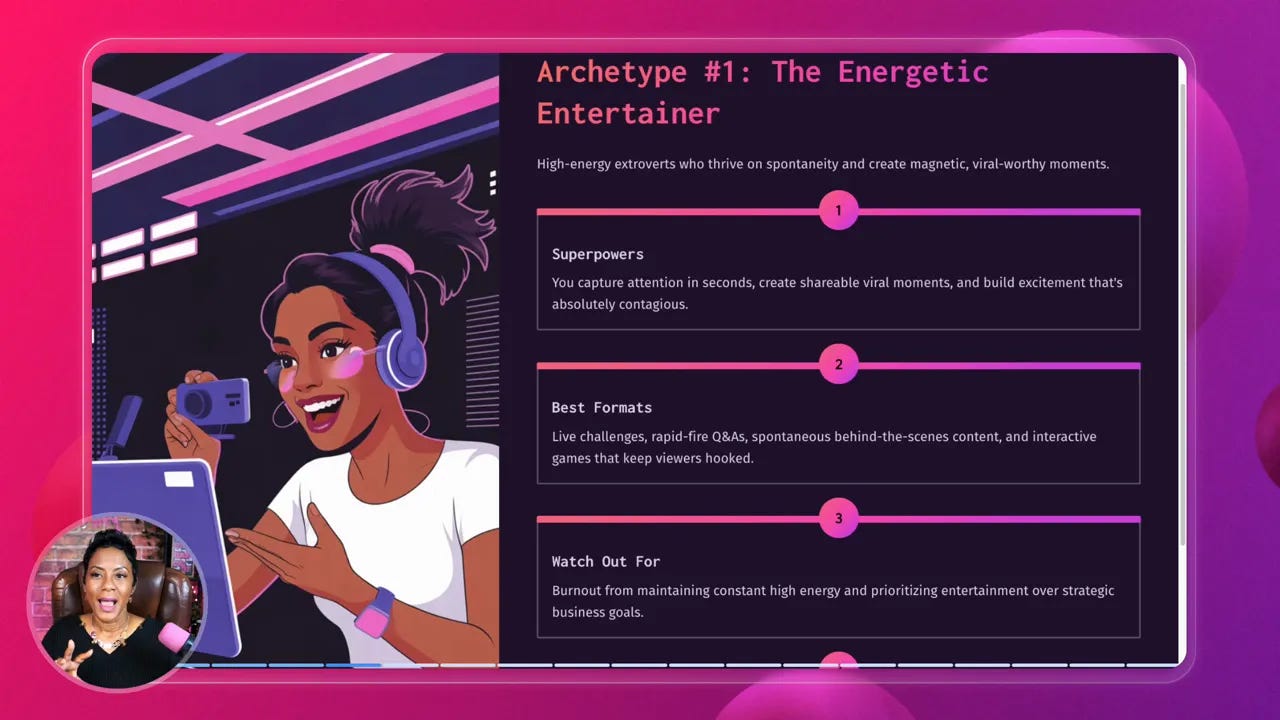
Who this is for: high-energy extroverts who feed on spontaneity and audience interaction. These creators love the live moment, confetti, sound effects, and getting immediate reaction from viewers.
Superpowers
Capture attention in seconds
Create shareable, viral moments naturally
Build contagious excitement and momentum
Best formats
Rapid-fire Q&As
Live challenges and competitions
Spontaneous behind-the-scenes and playful game segments
Audience-driven events like real-time polls and trivia
Pitfalls to watch
Burnout from sustaining constant high energy
Prioritizing entertainment over strategy and outcomes
Talking without intentionally guiding viewers to a call to action
How to make this work for business
Build structure into spontaneity. Use segment times and planned transitions so the energy funnels into a conversion path. For example, open with a high-energy hook, run your interactive segment, then transition to a short teaching or offer with a direct next step. The entertainer’s magnetism brings people in. Your structure converts them.
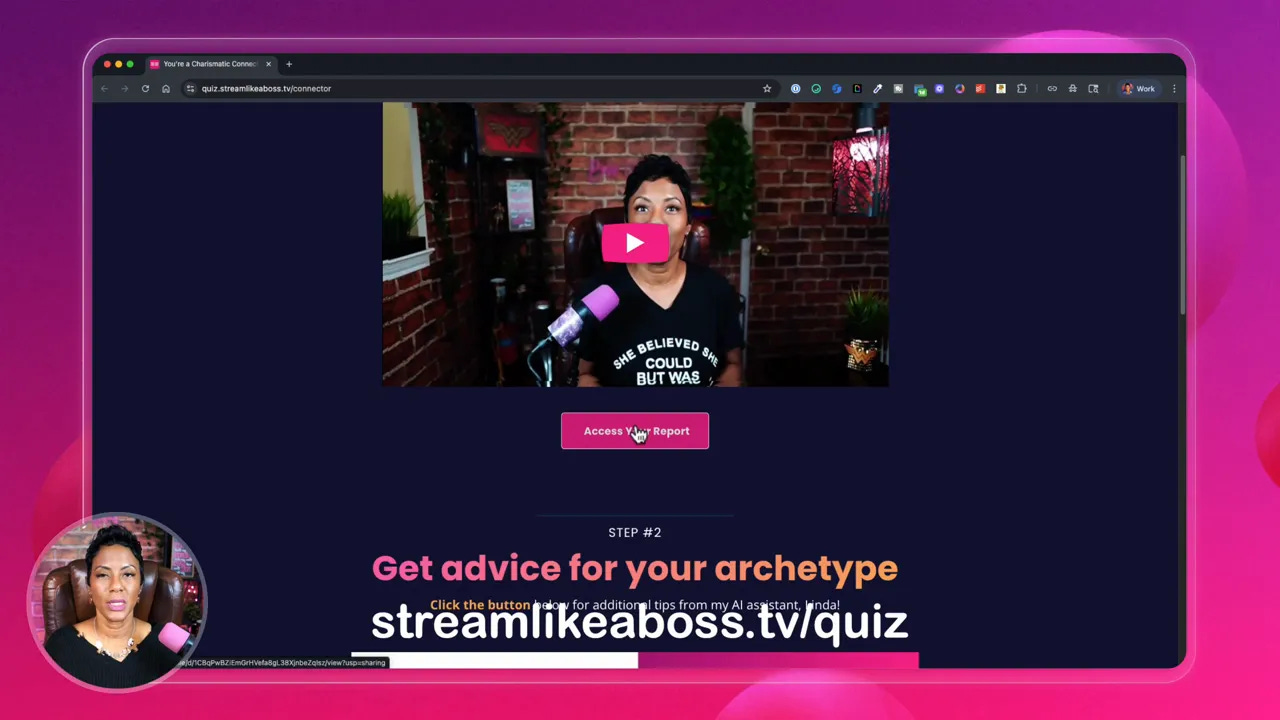
2. Charismatic Connector
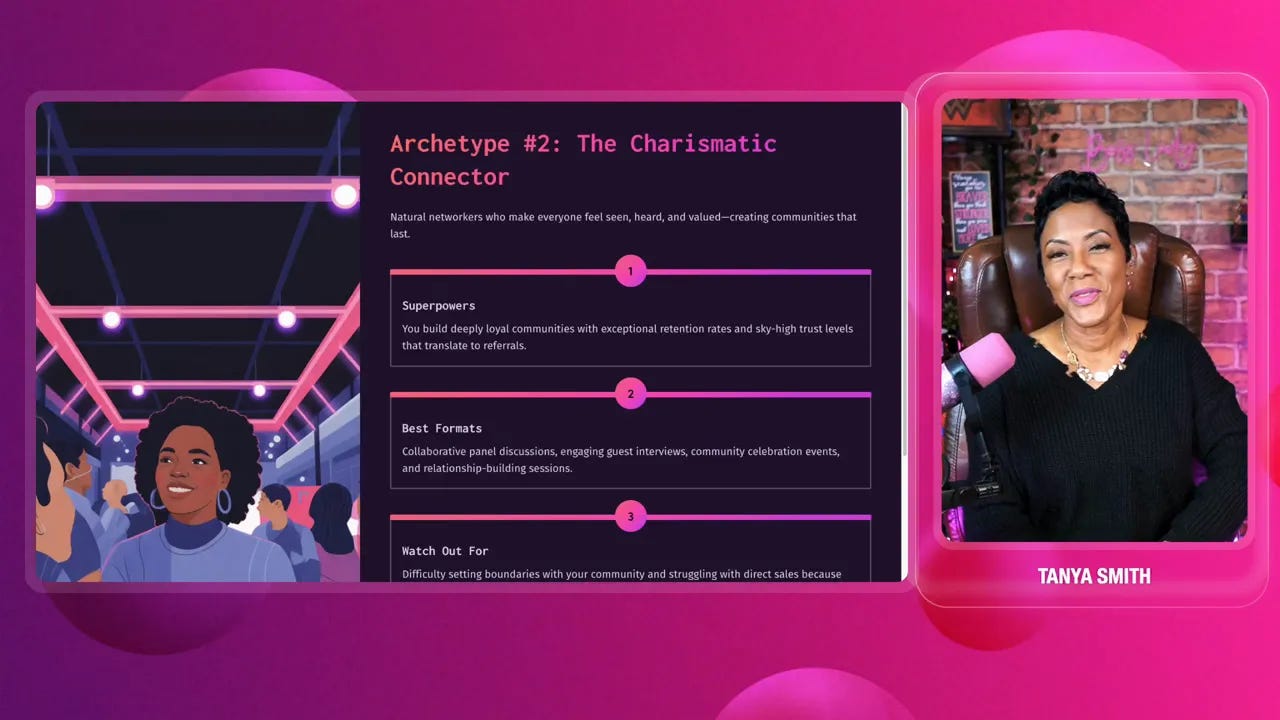
Who this is for: natural networkers and relational leaders. You remember names, create belonging, and thrive when building communal spaces that last.
Superpowers
Deep audience retention through relationship building
High trust and referral potential
Partnerships and collaborative content flourish
Best formats
Panel conversations and multi-guest interviews
Community celebrations and member spotlights
Collaborative series that co-promote across networks
Pitfalls to watch
Difficulty setting boundaries — always “on” and available
Discomfort with direct sales because it feels pushy
Spreading resources too thin across too many relationships
How to make this work for business
Reframe offers as invitations for deeper connection and transformation. For example, introduce a guest, have a conversational moment that shows the client’s transformation, then invite the audience to continue the conversation in a smaller group or program. That makes selling feel natural and relational rather than pushy.
3. Insightful Instructor (my primary)
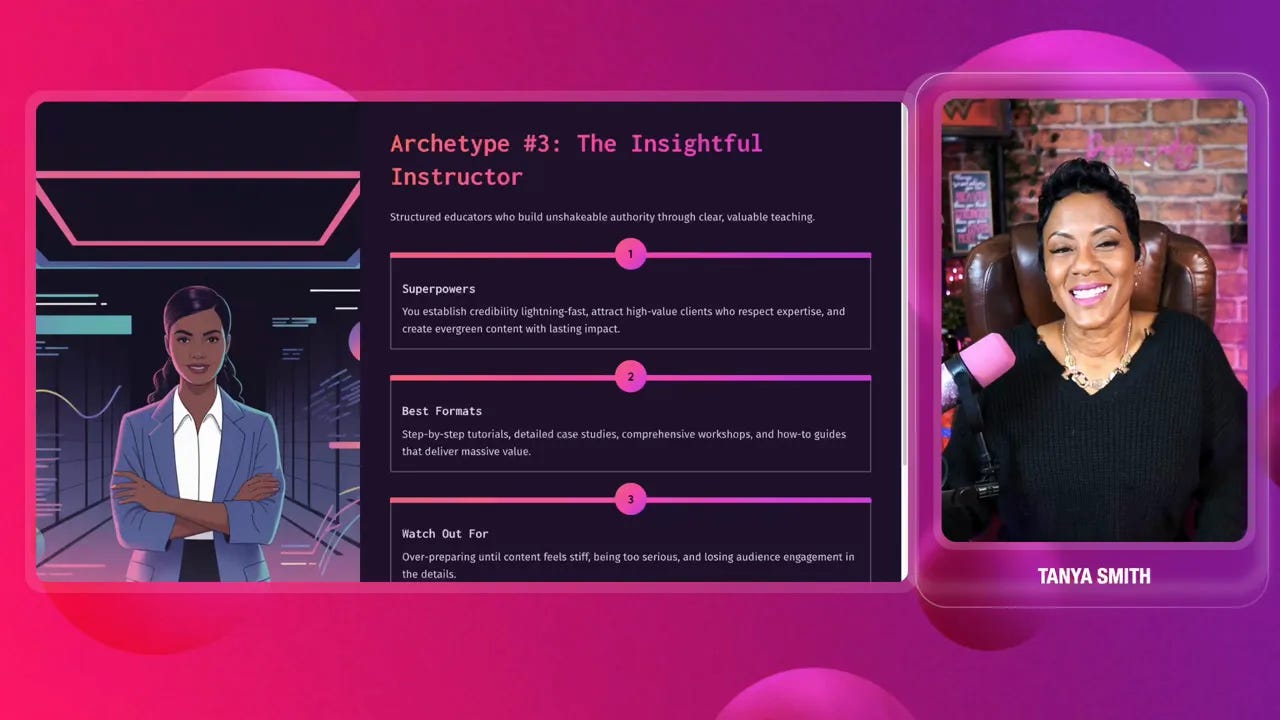
Who this is for: structured educators who build authority through teaching. If you love organizing information and translating complex concepts into step-by-step guidance, this archetype will feel like home.
Superpowers
Builds credibility fast
Attracts high-value clients who respect expertise
Creates evergreen content with long-term impact
Best formats
Step-by-step tutorials and how-to sessions
Detailed case studies and breakdowns
Comprehensive workshops and downloadable guides
Pitfalls to watch
Perfectionism and over-preparing can block output
Becoming too clinical or lecture-like, which reduces engagement
Forgetting to prompt interaction and co-creation
How to make this work for business
Intentionally insert engagement prompts and personality moments. As someone who is analytically driven, structure your session and then add prompts like “type 1 if this resonates” or short breakout activities. Use your strategic mind to design a content path that leads learners to a clear next step, whether that is a deeper workshop, a consulting call, or a paid program.
“Balance your natural structure with personality moments and interactive elements to keep viewers engaged.”
4. Storytelling Sage
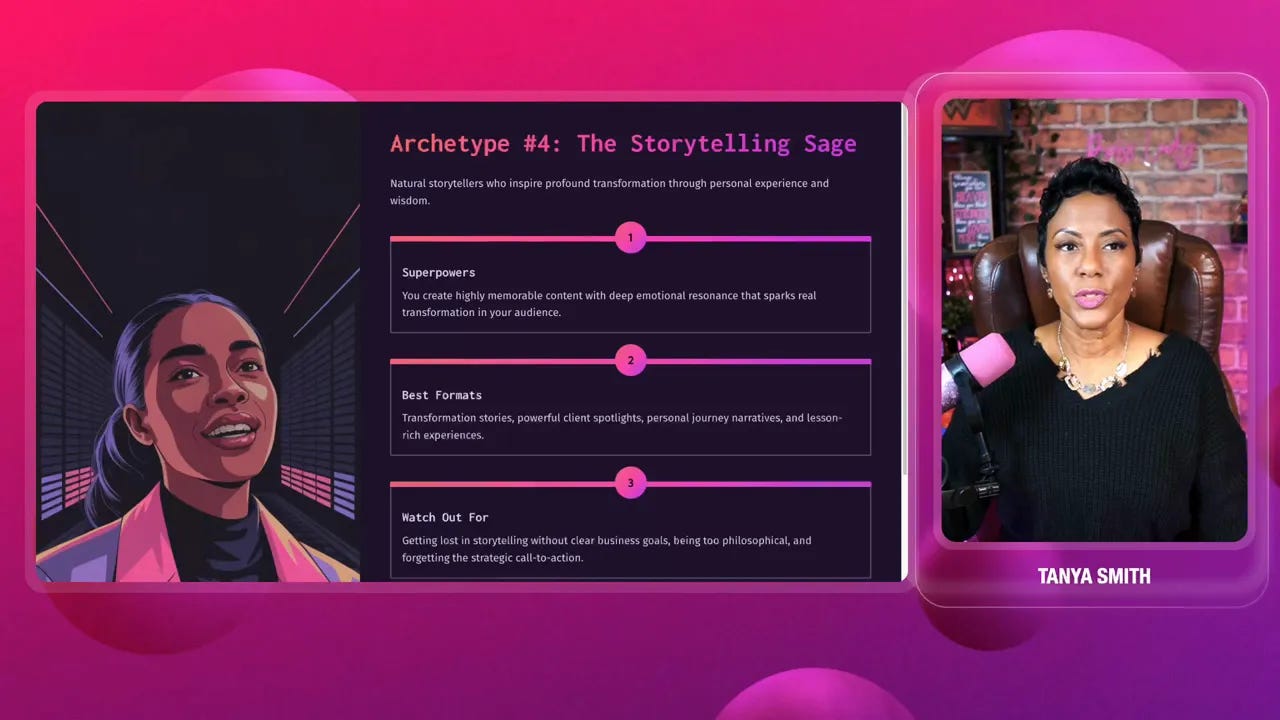
Who this is for: creators who excel at using personal narrative and client stories to create emotional transformation. You make people feel and remember through vivid, lesson-rich storytelling.
Superpowers
High memorability and emotional resonance
Content that sparks transformation and deep identification
Powerful client spotlights that demonstrate outcomes
Best formats
Transformation stories with clear before-and-after arcs
Client interviews that reveal process and results
Personal journey narratives with lesson takeaways
Pitfalls to watch
Getting lost in stories without clear business objectives
Long lectures that lack a concise takeaway or action
Turning philosophical discussion into vague outcomes
How to make this work for business
Pair every story with an actionable takeaway and a strategic call to action. Tell the story, then land the plane: summarize the lesson in one sentence, provide a quick application step and an invitation to get help implementing it. The emotional connection will open the door; your clarity and offer will guide the visitor to the next step.
How archetypes work together: blending without burning
Most people are not one archetype forever. You will likely have a primary and one or two secondary archetypes. The key is intentional blending.
Identify your primary archetype. This is where you will spend most of your on-camera energy.
Choose one secondary archetype to borrow from per episode. Make that borrowing temporary and tactical — for example, an Insightful Instructor can borrow the Energetic Entertainer’s opener for 3 minutes to skyrocket attention, then switch back to structured teaching.
Design transitions that signal an energy shift so the audience follows you. For example, a short musical sting or a visible shift in framing cues a change from story to action.
When you borrow, you do not try to become the other archetype permanently. Instead, you extract one or two behaviors that amplify your core strengths and funnel them into a business purpose.
Energy management and authenticity — practical tips
Here are tactical, psychology-informed steps you can implement right away to reduce burnout and increase authenticity:
Timebox energy peaks. Decide how long you will sustain high-intensity segments and build rest or lower-energy segments immediately after.
Use micro-scripts to manage transitions. A one-sentence bridge like “Quick example, then I will show you how” creates clarity and rhythm.
Design repurposing in advance. Know how a single broadcast will yield several pieces of content: short clips, a blog post, an email series. That reduces the pressure to “go viral” in one shot.
Map audience journeys. For each format, identify the desired next action and name it clearly on the show. That could be “book a call,” “join the mini-course,” or “download the worksheet.”
Create a content blueprint aligned to your archetype. Use a simple table: Hook, Value Segment, Interaction, Call to Action, Repurpose Plan.
Mini action plan — three concrete steps you can take this week
If you are a coach, consultant, or creative service provider, here are three high-impact steps to apply this framework immediately. These are tactical, low-friction moves designed to return value quickly while preserving your energy.
Identify your primary archetype
Write down which of the four archetypes most feels like home. Then list two signature moves that match that archetype—for me as an Insightful Instructor those are step-by-step breakdowns and a downloadable guide.Create a single archetype-aligned episode
Plan one show that leverages your primary strength and includes a built-in call to action. If you are a Charismatic Connector, create a 45-minute panel and end with an invitation to a small group session. Timebox each segment so the show remains purposeful.Repurpose with precision
From that episode, create three assets: a short 60-second clip tailored to platform trends, a 300-word guide or checklist, and an email that summarizes the transformation with a clear next step. This makes your effort multiply without additional live energy.
Memorable quotes and takeaways
Throughout this conversation-style guide, a few lines stood out as both tactical and philosophical. I keep them at eye level for their clarity and strategic value:
“Stop thinking about performing. Think about connecting.”
“When you operate in your natural state, you attract the right clients — not just more clients.”
“Build enough structure around your spontaneity to channel energy into business results.”
These are not slogans. They are principles I test repeatedly. They shape decisions like how long I go live, what segments I include, and how I design a clear outcome for viewers.
Final notes on measurement and iteration
As someone who values analysis and strategic iteration, I recommend tracking three metrics per broadcast:
Engagement rate: comments, reactions, and poll participation
Conversion step: clicks to your offer, signups, or booked calls
Energy sustainability: How you felt the next day and how many days of recovery you needed
Run a 90-day experiment where you keep your primary archetype consistent.
Measure the metrics above and adjust one variable each cycle — segment length, engagement prompts, transition scripts, or call-to-action phrasing. Small, strategic changes are how consistent creators win.
Join the conversation
I love this kind of work because it combines psychology with practical strategy. My strengths push me to analyze, iterate, and craft systems that allow you to show up consistently without emptying your tank. If you try any of these ideas, please tell me about it — what you planned, how it felt, and what the results were.
Subscribe to the channel where you follow my work, leave a review if this format helped you, and drop a comment sharing which archetype you identified as. I read every comment and use them as data to refine future sessions.
Here is the simplest call to action: pick one archetype-aligned episode to produce this week. Make it short, purposeful, and measurable. You will be surprised how quickly clarity turns into momentum.
Show up as yourself, boldly and powerfully!

About the Author
Tanya Smith is the CEO of Get Noticed with Video LLC and host of Stream Like a Boss® TV, where she helps podcasters and livestream creators turn crickets into clients—without chasing algorithms or losing their authentic voice. Through practical strategies and proven workflows, Tanya empowers creators to grow their audience, build authority, and monetize their message with confidence.
🎯 Want to know your unique livestream personality type?
Take the free quiz now: streamlikeaboss.tv/quiz


